
International
Bolsonaro against Brazil resuming carnival
AFP
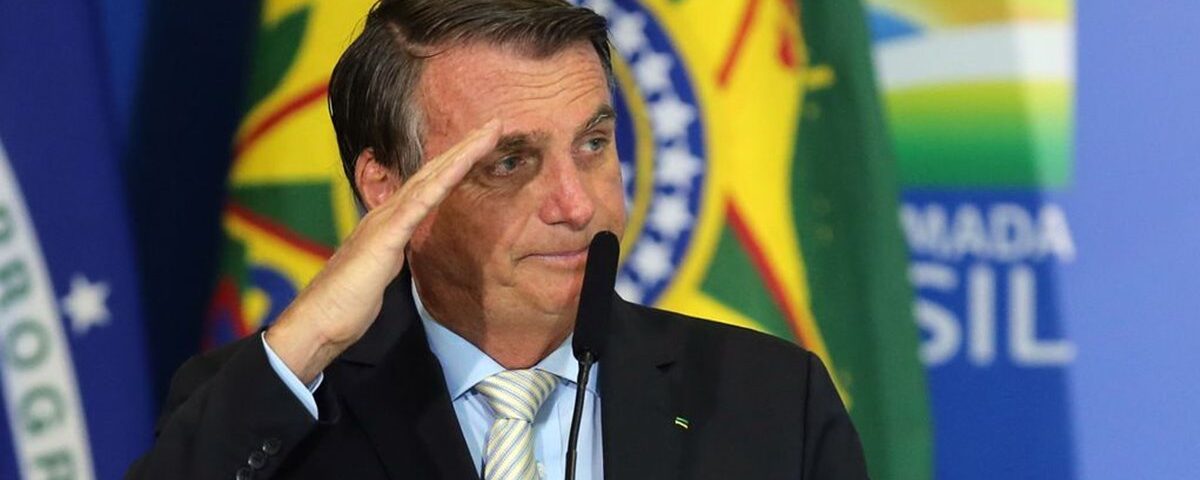
President Jair Bolsonaro said Thursday he was against Brazil resuming carnival celebrations in February, a rare nod to Covid-19 social distancing measures from the far-right leader.
“As far as I’m concerned, we shouldn’t have carnival,” Bolsonaro, 66, said in an interview, as Brazil debates whether to go ahead with the festivities held from February 25 to March 1.
Carnival was canceled in Brazil this year because of the pandemic.
But authorities are considering allowing it to go ahead in 2022, given a sharp drop in the number of Covid-19 cases and deaths in Brazil.









Bolsonaro said he believed it was too soon, but that the decision was up to state and local authorities.
“I don’t want to get involved, because it could just cause another controversy,” he told radio network Sociedade.
“Last February, the pandemic was just arriving, we didn’t know much about it. I declared an emergency and the governors and mayors all ignored it. They went ahead with carnival. Then the consequences came, and people try to say I’m the one responsible.”
Bolsonaro appeared to be referring to a February 2020 bill passed by Congress declaring Covid-19 a public health emergency, which he signed into law.
He did not mention his more controversial handling of the virus, which he downplayed as a “little flu,” attacking stay-at-home measures, face masks and vaccines.
A Senate investigative commission last month said it had found evidence Bolsonaro committed 10 crimes in his pandemic response, including “crimes against humanity.”
Despite his anti-vaccine statements, hard-hit Brazil has massively scaled up its immunization campaign in recent months.
With more than 60 percent of Brazil’s 213 million people now fully vaccinated, the average daily Covid-19 death toll has fallen from more than 3,000 in April to around 200.






International
Venezuela Earthquake Death Toll Surpasses 1,700 as Search for Survivors Continues
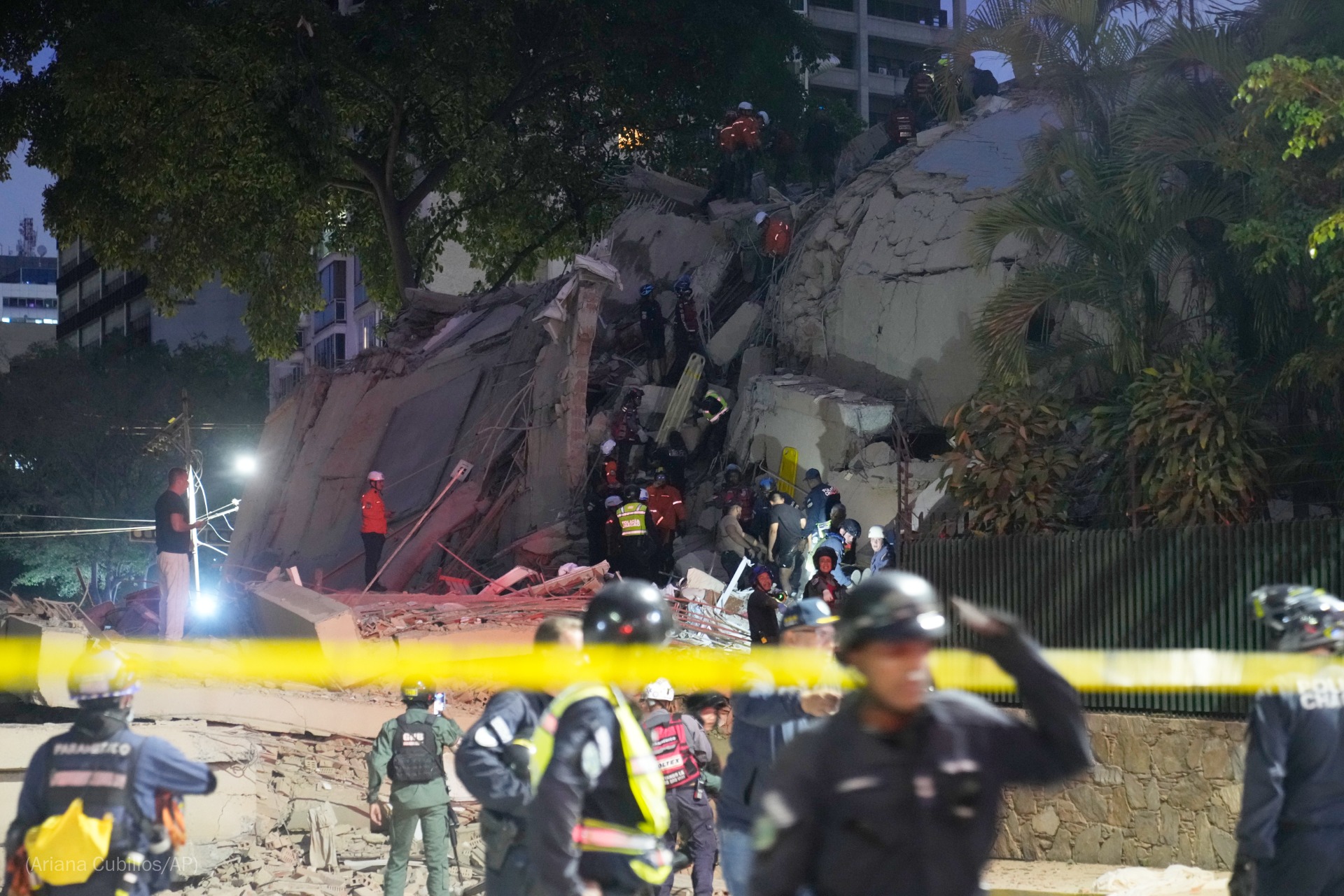
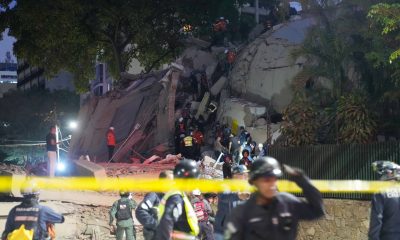
Venezuelan authorities have raised the death toll from last week’s twin earthquakes to more than 1,700, as rescue teams continue searching for survivors in the country’s hardest-hit coastal region.
According to the latest official report released on Sunday, the powerful earthquakes, measuring magnitudes 7.2 and 7.5, have claimed at least 1,719 lives. National Assembly President Jorge Rodríguez also reported that 5,034 people were injured, while 15,866 have been displaced and another 22,619 are receiving medical care.
The United Nations has expressed growing concern over the scale of the disaster, estimating that as many as 68,000 people could still be missing.
La Guaira bears the brunt of the disaster
The coastal state of La Guaira has suffered the greatest loss of life and the most extensive damage. The Venezuelan government has declared the area a disaster zone and placed it under military control as emergency operations continue.
Five days after the earthquakes struck, search-and-rescue teams remain on the ground, supported by additional heavy equipment and international rescue crews. However, hopes of finding more survivors beneath the rubble continue to diminish with each passing day.
One of the most dramatic rescue operations unfolded Monday in Catia La Mar, where emergency teams from El Salvador, Mexico, and Venezuela worked together to reach a 21-year-old man who has remained trapped inside a collapsed building since the earthquakes struck.
The twin earthquakes hit Venezuela on June 24, with the epicenter located between San Felipe and Yumare in the country’s northern region. The first quake, measuring magnitude 7.2, struck at 6:04 p.m. local time. Just 39 seconds later, a second and stronger magnitude 7.5 earthquake occurred farther to the southeast. Combined, the seismic activity lasted nearly three minutes, causing widespread devastation across several regions of the country.
International
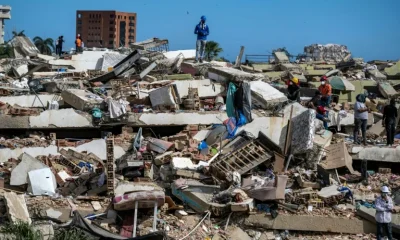
Looting Spreads in Venezuela’s Hardest-Hit Areas After Deadly Earthquakes
Not even the wires were left behind at a small grocery store. Before the ground had even stopped shaking, looting and theft began in the areas hardest hit by the double earthquake that struck Venezuela.
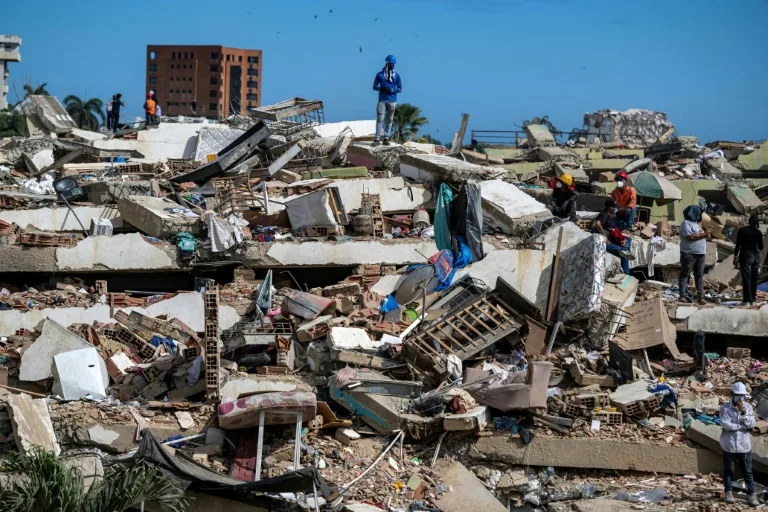
Reports of robberies have multiplied in the coastal state of La Guaira, located near Caracas and now transformed into a landscape of collapsed buildings and debris.
Videos circulating on social media show groups of people removing boxes of household appliances from a damaged store. Other images show similar boxes being carried on top of vehicles and motorcycles.
Social media platforms have also been filled with accusations against police officers and military personnel who allegedly stole from homes and even from victims who died during the disaster.
A branch of a major pharmacy chain was looted, along with supermarkets and other businesses. Some residents have described the situation as “disaster tourism,” while others say the looting reflects hunger and desperation among people who lost everything in a country already facing a prolonged economic crisis.
“Is it fair that our own people turn against our own people?” said María Esther Bernal, 71, who rented commercial spaces to Chinese merchants, all of which were looted. “They left nothing behind, not even the wallpaper. They even took the cables,” she said.
“Next door, a man died. He was Chinese. People walked over his body while they looted the place. It was a supermarket,” she added.
An AFP journalist witnessed looting in La Guaira since Thursday, following the earthquakes.
Jenifer Mayora, 34, defended some of the actions, saying that “the things people took were because the owners of the stores allowed us to take them.”
However, she criticized the limited response from authorities. “I have been waiting for a mattress so my children can sleep,” she said.
Residents have expressed anger over what they describe as a slow and insufficient response from authorities after the double earthquake, which has left around 1,450 people dead and tens of thousands missing.
Communities are demanding not only faster rescue operations in La Guaira, but also stronger security measures and urgent assistance with food, water, and medicine.
International
UN warns Venezuela earthquakes could affect up to 6.76 million people
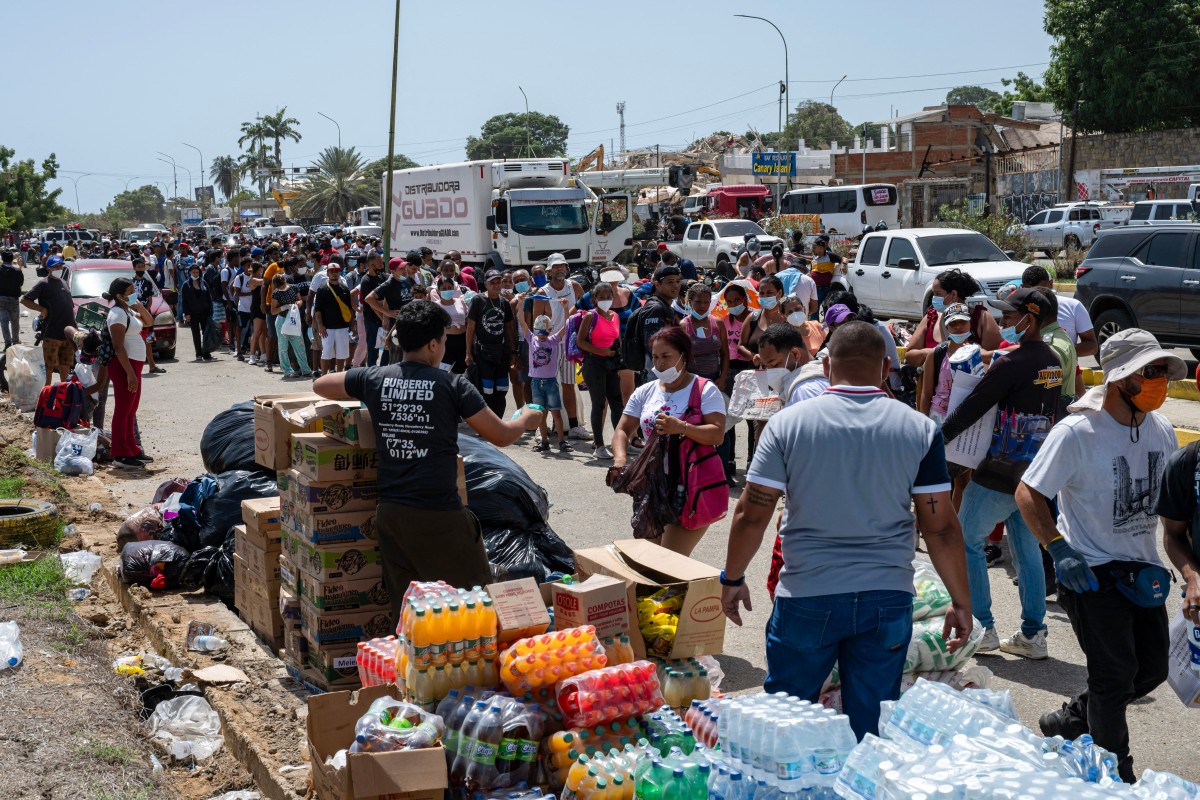
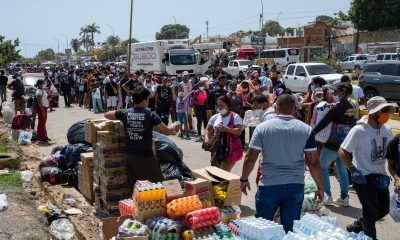
Up to 6.76 million people could be affected by the devastating earthquakes that struck Venezuela on June 24, according to an assessment released by the International Organization for Migration (IOM), a United Nations agency.
The organization said the projections are based on available population data and damage assessments, and include up to two million people living in Caracas, the country’s capital.
The estimates highlight the potentially massive humanitarian impact of the disaster, the IOM warned.
Entire buildings collapsed in La Guaira, a coastal area north of Caracas, following the powerful twin earthquakes that reached magnitudes of 7.2 and 7.5 on Wednesday.
The national death toll has risen to 920, while rescue teams continue searching for people trapped beneath the rubble in coastal regions and other affected areas.
UN humanitarian chief Tom Fletcher told AFP on Friday that more than 50,000 people were reported missing.
The IOM also revealed that it worked with Microsoft’s artificial intelligence laboratory on an initial satellite mapping analysis, which showed that 31.5% of buildings in the town of Catia La Mar had suffered damage.
Authorities and international rescue teams continue operations as Venezuela faces one of its largest humanitarian emergencies in recent years.

Venezuela Earthquake Death Toll Surpasses 1,700 as Search for Survivors Continues

Looting Spreads in Venezuela’s Hardest-Hit Areas After Deadly Earthquakes

UN warns Venezuela earthquakes could affect up to 6.76 million people
Tec de Monterrey honors one of its students for his contribution to nanotechnology in medicine

Defense Minister commends salvadoran soldier for Central American Cross Country victory

Extension of the state of emergency approved in southern Chile
-
 International23 hours ago
Looting Spreads in Venezuela’s Hardest-Hit Areas After Deadly Earthquakes
-
 International4 days ago
OAS Secretary General Pledges Regional Assistance Following Venezuela Quake Disaster
-
 International4 days ago
United Nations Coordinates Relief Efforts as Venezuela Death Toll Rises After Twin Quakes
-
 International2 days ago
UN warns Venezuela earthquakes could affect up to 6.76 million people
-
 International9 seconds ago
Venezuela Earthquake Death Toll Surpasses 1,700 as Search for Survivors Continues