
International
Thousands of protesters expected in Peru’s capital
January 19 | By AFP | Carlos Mandujano / Luis Jaime Cisneros |
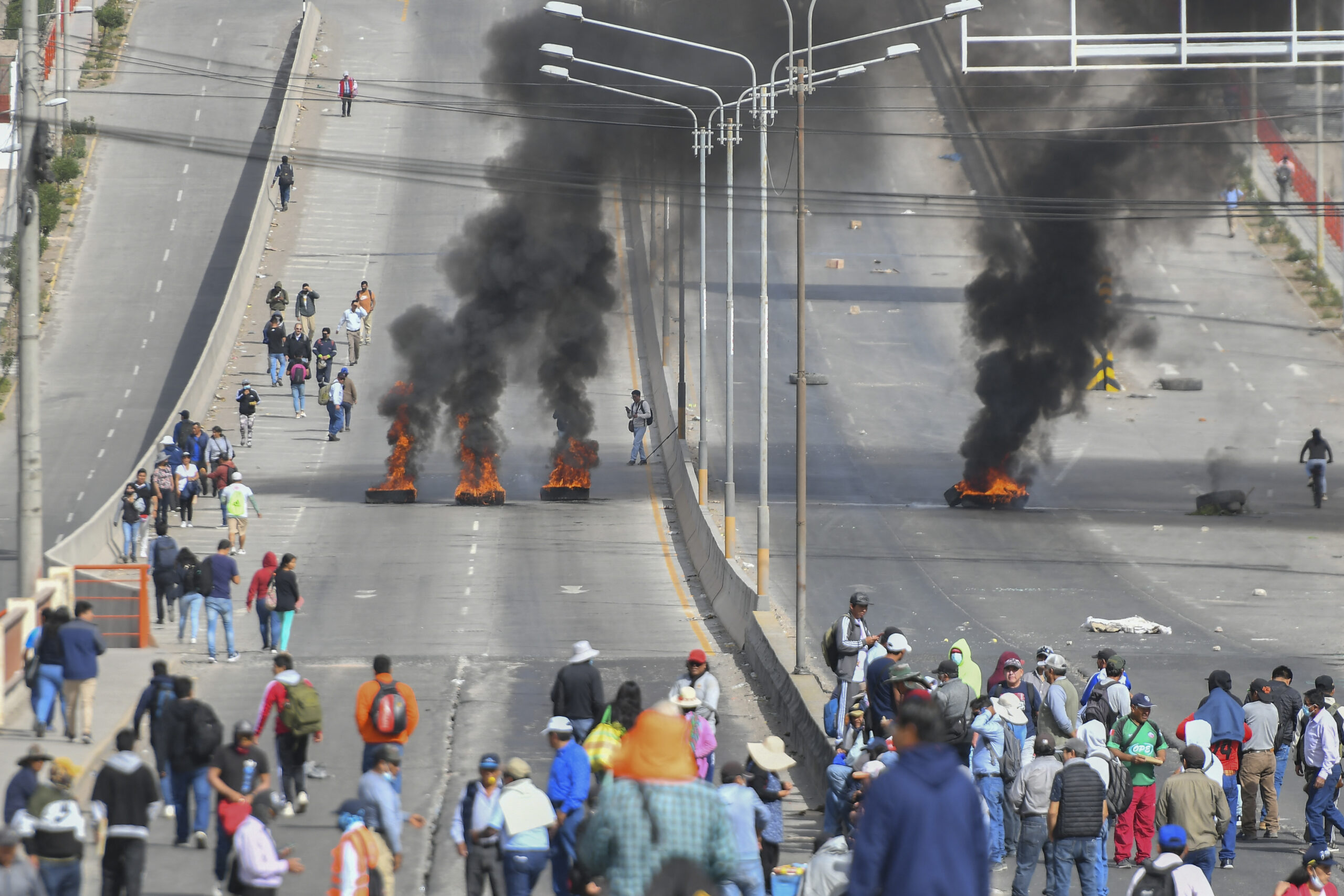
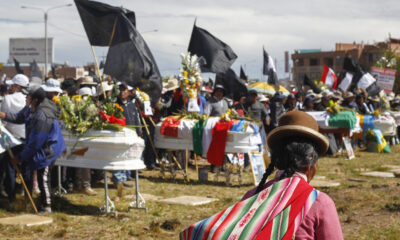
Thousands of protesters were expected to descend on Peru’s capital Lima on Thursday, defying a state of emergency to express their anger with President Dina Boluarte after weeks of unrest.
One demonstrator was killed on Wednesday in clashes with police in the country’s south, raising tensions and bringing the death toll from the protests to 43, according to Peru’s human rights ombudsman.
The South American country has been rocked by more than a month of protests, mostly in the southern and eastern areas, since the ouster and arrest of Boluarte’s predecessor Pedro Castillo in December.
On Wednesday, a 35-year-old woman was killed in the southern Puno region, according to a hospital statement. At least one other person, a 30-year-old man, was injured in the demonstrations, the statement said.











Thousands of protesters from rural areas are expected to descend on Lima this week to keep up pressure against the government, defying a state of emergency declared to maintain order.
“We are coming to make our voices heard. We are tremendously forgotten,” villager Edwin Condori, 43, from the Cusco region, told AFP.
Demonstrators in Lima are expected to call for Boluarte’s resignation, the dissolution of parliament and fresh elections.
Although protestors across the country have vowed to meet in the capital, it is difficult to determine how many will arrive.
Counter-protests are already underway in a sign of divisions wracking the country.
One of Peru’s biggest labor unions, the General Confederation of Workers, has called a strike for Thursday.
‘She doesn’t represent us’
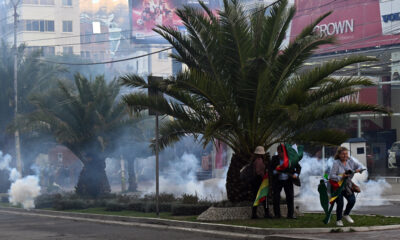
On Tuesday, many poor and Indigenous demonstrators made their presence felt in Lima, where police used smoke canisters against marchers who had gathered ahead of larger mobilizations.
Dozens marched through the capital’s streets to Plaza San Martin, the historic epicenter of demonstrations.
Boluarte urged protesters flooding into Lima to gather “peacefully and calmly.”
“We want Dina Boluarte’s resignation. We don’t feel that she represents us,” said Jesus Gomez, an agricultural engineer from Chumbivilcas in the Cusco region.
“We have come in an organized way to take over Lima, to paralyze Lima, to be heard,” he said.
But the president warned protesters that “the rule of law cannot be hostage to the whims” of a single group of people.
“Dina Boluarte should leave because she does not represent the coast, the mountains, or the jungle,” said teacher Edith Calixto, 45 from the Andes.
Residents of the northern city of Cajamarca carried signs that read “National Insurgency.” Some held “rondero” whips of the type used by local patrols in rural areas.
“Dina, please, resign so that this town calms down because the town is not going to give up,” Antonia Riveros, a 55-year-old native of Huancavelica, said.
Rival protests
A rival “march for peace” was also underway in Lima, with dozens of members from community groups and political parties wearing white T-shirts in rejection of the protests against Boluarte.
“We do not want violence in our country. I know that now there is a group that disagrees with the current government, but nevertheless it is not the way to carry out a protest,” 56-year-old merchant Cesar Noa told AFP.
Protesters have maintained almost 100 roadblocks across Peru.
Castillo was removed from office and arrested on December 7 after attempting to dissolve the country’s legislature and rule by decree, amid multiple corruption investigations.
Boluarte, who was Castillo’s vice president, succeeded him. But despite Boluarte belonging to the same left-wing party, Castillo supporters have rejected her, even accusing her of being a “traitor.”































International
Pilot killed and two Pennsylvania state troopers injured in mid-air collision

A pilot was killed and two Pennsylvania state police officers were injured when a Cessna 150 airplane collided with the helicopter they were traveling in during a routine training exercise at a regional airport in the state.
Pennsylvania Governor Josh Shapiro identified the officers as Corporal Bryce Corman and Trooper Jason Mills, members of the Pennsylvania State Police aviation unit. Both are expected to recover from their injuries, according to ABC.
The county coroner’s office identified the pilot as 57-year-old Paul Sokoloski.
George Bivens, acting commissioner of the Pennsylvania State Police, said the collision occurred at around 6:50 p.m. Wednesday. The helicopter was flying several feet above a grassy area near a runway at Carlisle Regional Airport when the small plane approached from behind.
According to investigators, the Cessna suddenly veered to the right moments before the collision, striking the helicopter’s tail rotor before also hitting its main rotor.
The airplane crashed a short distance away and broke into several pieces, while the helicopter lost its tail and other components before crashing on its side.
Police said Corporal Corman opened a window and helped Trooper Mills escape from the helicopter because they feared the aircraft could catch fire.
The Federal Aviation Administration and the National Transportation Safety Board are investigating the circumstances surrounding the crash.
International
Argentina’s Milei Links Low Birth Rates to Abortion and Feminism

Argentine President Javier Milei on Thursday blamed feminism and the legalization of abortion for the country’s declining birth rate, arguing that the demographic trend is creating economic and pension-system challenges.
“We are paying a very high price for the madness of the green scarves,” Milei said during a speech at the Council of the Americas in Buenos Aires, referring to the symbol associated with the feminist movement and the campaign for legal abortion in Argentina.
According to Milei, Argentina is failing to reach the population growth and birth rates needed to maintain demographic replacement.
He also linked the decline in births to future challenges for the country’s pension system and workforce.
“That passion for killing children in the mother’s womb is costing us in terms of growth and pensions. It is also costing us in terms of human capital,” the president said.
Milei has consistently opposed abortion, which has been legal in Argentina since 2020. The law was considered a major victory for the feminist movement across Latin America at the time of its approval.
In February 2024, lawmakers from Milei’s La Libertad Avanza (LLA) party introduced a bill seeking to repeal voluntary abortion legislation.
Under Argentina’s current law, abortion is legal, safe and free of charge up to the 14th week of pregnancy. After that period, it is permitted when the pregnancy poses a risk to the woman’s life or health, or when it resulted from rape.
Milei has repeatedly criticized abortion
The Argentine president has also criticized abortion and feminism in international forums. During his speech at the World Economic Forum in Davos in January 2024, he attacked the feminist movement and denounced what he described as the “bloody agenda of abortion.”
His latest comments come amid growing concerns over Argentina’s demographic outlook and the potential long-term effects of declining birth rates on economic growth, the labor force and social security.
International
Virginia Police Arrest Salvadoran Man in Great Falls Woman’s Killing

Alexis Antonio Cedillos-Campos, 19, identified by federal officials as an undocumented immigrant from El Salvador, was arrested in connection with the death of Carmen Lizet Puch, 42, who was found dead Monday, the Fairfax County Police Department said.
Authorities said Cedillos-Campos and Puch were coworkers and were also involved in an “intimate relationship.”
“Our victim suffered numerous stab wounds in a truly brutal and indescribable manner,” Police Chief Kevin Davis said during a news conference Wednesday.
Investigators said surveillance video showed Cedillos-Campos at the restaurant where he and Puch worked, allegedly taking a fixed-blade knife, a pair of black latex gloves and a bottle of water before leaving.
“He left with the intent to harm and kill the victim,” Davis said.
Cedillos-Campos was arrested Wednesday morning in Maryland and confessed to the killing, according to Davis. He is awaiting extradition to Virginia. Authorities have not said whether he has an attorney representing him.
The Department of Homeland Security said Cedillos-Campos had previously been arrested by U.S. Customs and Border Protection in 2024 after allegedly crossing the U.S.-Mexico border illegally near El Paso, Texas.


Panama’s Geisha Coffee Retains Pure Ethiopian Genetics, Studies Find

Pilot killed and two Pennsylvania state troopers injured in mid-air collision

Argentina’s Milei Links Low Birth Rates to Abortion and Feminism

Virginia Police Arrest Salvadoran Man in Great Falls Woman’s Killing

Honduran Lawyer and Protected Witness in Angie Peña Case Shot Dead

Mexico and Guatemala Agree on Five-Point Binational Plan for 2027

France to Expel Two Iranian Diplomats Over Alleged Attack on French Officials

Heat wave puts more than 70 million Americans under alerts as temperatures near 46°C
France to Expel Two Iranian Diplomats Over Alleged Attack on French Officials
Honduran Lawyer and Protected Witness in Angie Peña Case Shot Dead
Virginia Police Arrest Salvadoran Man in Great Falls Woman’s Killing
Argentina’s Milei Links Low Birth Rates to Abortion and Feminism
Pilot killed and two Pennsylvania state troopers injured in mid-air collision
Mexico and Guatemala Agree on Five-Point Binational Plan for 2027
Panama’s Geisha Coffee Retains Pure Ethiopian Genetics, Studies Find
-
 International4 days ago
France to Expel Two Iranian Diplomats Over Alleged Attack on French Officials
-
 Central America3 days ago
Honduran Lawyer and Protected Witness in Angie Peña Case Shot Dead
-
 International3 days ago
Virginia Police Arrest Salvadoran Man in Great Falls Woman’s Killing
-
 International2 days ago
Argentina’s Milei Links Low Birth Rates to Abortion and Feminism
-
 International2 days ago
Pilot killed and two Pennsylvania state troopers injured in mid-air collision
-
 International4 days ago
Mexico and Guatemala Agree on Five-Point Binational Plan for 2027
-
 Central America2 days ago
Panama’s Geisha Coffee Retains Pure Ethiopian Genetics, Studies Find