
International
Venezuela shows evidence of fraud in primary event
October 27 |
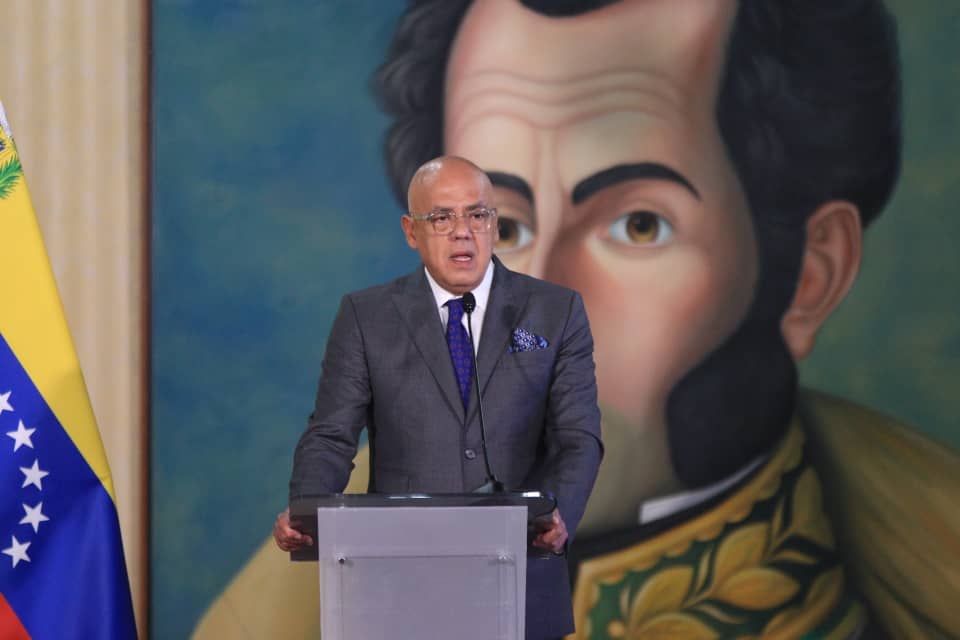
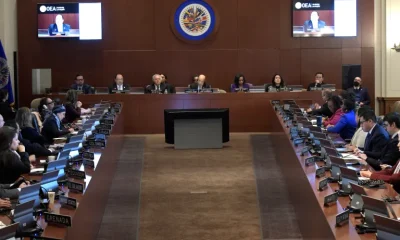
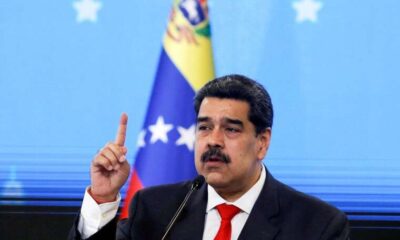
The president of the National Assembly (AN) of Venezuela, Jorge Rodríguez, met in Caracas with representatives of the diplomatic corps accredited in the country and exposed details of the agreements assumed by the National Government and a sector of the opposition to contextualize the evidence of the fraudulent primary event that took place last October 22.
He referred that recently the National Government signed in the capital of Barbados with representatives of the oppositions two agreements: one related to the political and electoral conditions, with a view to the presidential election of 2024, and the other which expressed the firm intention to defend the territorial integrity of Venezuela and to defend the Venezuelan patrimony and assets that are abroad.
He pointed out that the first of them seeks that the results of that election be shared by all and that they may be fair, verifiable and supported by the goodness and strengths of the national electoral system, considered one of the most reliable, efficient and fast in the world. All this was embodied in this agreement, he emphasized.
He reminded that it is a robust and reliable automated system, and throughout it there are 18 audits (including the inspection by experts of the machines, the software, the electoral registry, the machine set to zero on the day of the elections and the voting records, among many others).











He explained that in one of its paragraphs, the agreement on the elections makes it clear that these conditions will be applied to the rest of the electoral processes to be carried out in the country.
He emphasized that political parties in Venezuela are subject to public scrutiny and to the provisions of the Constitution and electoral laws, such as the Organic Law of Electoral Processes, the Comptrollership Law and others. He made clear that these parties “are not secret brotherhoods, they are not private companies, they are not anonymous companies” and must adhere to the mandate of the law.
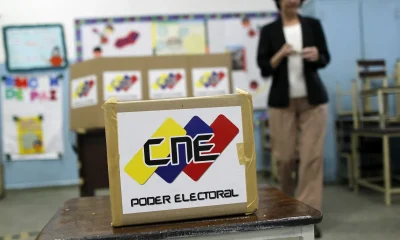
In addition to these standards, during the signing of the agreements it was defined that the National Electoral Council (CNE) is the only entity legally vested in the country to summon, organize and carry out elections of any kind and thus avoid any irregularity.
He added that on two occasions the NEC communicated with the organizations with political purposes which conform the so called Unitary Platform and on both occasions this sector refused to allow the NEC to organize the election.
He questioned the refusal of this sector to use the voting centers and tables, the electronic machines and all the support usually provided by the CNE. He assured that this could only be explained because a fraud of incalculable proportions had been organized.
He denounced that there were no voting centers and people did not know where to go to vote. Very few were known to exist and with very vague coordinates. On the other hand, 30 percent of the voting centers were inside private residences.
He commented that then began to appear denunciations of candidates and resignations of members of the boards of this primary event in the states, among them the vice-president of the national commission of the event, who claimed the participation of the CNE in this process.
She said that the resignations of candidates prevented the election from being participatory. How can an election be competitive if there is only one candidate left with possibilities, since two others resigned, she asked. He assured that what happened on Sunday, October 22 cannot be considered an election. It does not have any quality or verifiability.
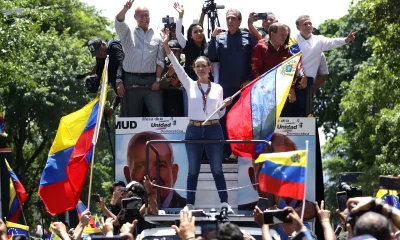
He commented that another candidate explained that there were no voting centers, it was not known who the witnesses were and the audited electoral material had not arrived, among other irregularities. He said that weeks before the primary event, a private company called Súmate -owned by María Corina Machado- hijacked the primary event and, for example, created mega voting centers -with 6,000, 10,000 voters, for example- which prevented thousands of voters from voting.
He affirmed that 25 percent of the 5,000 voting tables were never installed. He emphasized that the objective of all this was to create agglomeration and irritation among his own followers, in addition to trying to mediatically implant an opinion matrix favorable to anxiety and to politically annihilate the parties that signed the agreements in Barbados.
There is no election if you cannot present medium or minimally reliable results, said Rodriguez.





























































International
Pilot killed and two Pennsylvania state troopers injured in mid-air collision

A pilot was killed and two Pennsylvania state police officers were injured when a Cessna 150 airplane collided with the helicopter they were traveling in during a routine training exercise at a regional airport in the state.
Pennsylvania Governor Josh Shapiro identified the officers as Corporal Bryce Corman and Trooper Jason Mills, members of the Pennsylvania State Police aviation unit. Both are expected to recover from their injuries, according to ABC.
The county coroner’s office identified the pilot as 57-year-old Paul Sokoloski.
George Bivens, acting commissioner of the Pennsylvania State Police, said the collision occurred at around 6:50 p.m. Wednesday. The helicopter was flying several feet above a grassy area near a runway at Carlisle Regional Airport when the small plane approached from behind.
According to investigators, the Cessna suddenly veered to the right moments before the collision, striking the helicopter’s tail rotor before also hitting its main rotor.
The airplane crashed a short distance away and broke into several pieces, while the helicopter lost its tail and other components before crashing on its side.
Police said Corporal Corman opened a window and helped Trooper Mills escape from the helicopter because they feared the aircraft could catch fire.
The Federal Aviation Administration and the National Transportation Safety Board are investigating the circumstances surrounding the crash.
International
Argentina’s Milei Links Low Birth Rates to Abortion and Feminism

Argentine President Javier Milei on Thursday blamed feminism and the legalization of abortion for the country’s declining birth rate, arguing that the demographic trend is creating economic and pension-system challenges.
“We are paying a very high price for the madness of the green scarves,” Milei said during a speech at the Council of the Americas in Buenos Aires, referring to the symbol associated with the feminist movement and the campaign for legal abortion in Argentina.
According to Milei, Argentina is failing to reach the population growth and birth rates needed to maintain demographic replacement.
He also linked the decline in births to future challenges for the country’s pension system and workforce.
“That passion for killing children in the mother’s womb is costing us in terms of growth and pensions. It is also costing us in terms of human capital,” the president said.
Milei has consistently opposed abortion, which has been legal in Argentina since 2020. The law was considered a major victory for the feminist movement across Latin America at the time of its approval.
In February 2024, lawmakers from Milei’s La Libertad Avanza (LLA) party introduced a bill seeking to repeal voluntary abortion legislation.
Under Argentina’s current law, abortion is legal, safe and free of charge up to the 14th week of pregnancy. After that period, it is permitted when the pregnancy poses a risk to the woman’s life or health, or when it resulted from rape.
Milei has repeatedly criticized abortion
The Argentine president has also criticized abortion and feminism in international forums. During his speech at the World Economic Forum in Davos in January 2024, he attacked the feminist movement and denounced what he described as the “bloody agenda of abortion.”
His latest comments come amid growing concerns over Argentina’s demographic outlook and the potential long-term effects of declining birth rates on economic growth, the labor force and social security.
International
Virginia Police Arrest Salvadoran Man in Great Falls Woman’s Killing

Alexis Antonio Cedillos-Campos, 19, identified by federal officials as an undocumented immigrant from El Salvador, was arrested in connection with the death of Carmen Lizet Puch, 42, who was found dead Monday, the Fairfax County Police Department said.
Authorities said Cedillos-Campos and Puch were coworkers and were also involved in an “intimate relationship.”
“Our victim suffered numerous stab wounds in a truly brutal and indescribable manner,” Police Chief Kevin Davis said during a news conference Wednesday.
Investigators said surveillance video showed Cedillos-Campos at the restaurant where he and Puch worked, allegedly taking a fixed-blade knife, a pair of black latex gloves and a bottle of water before leaving.
“He left with the intent to harm and kill the victim,” Davis said.
Cedillos-Campos was arrested Wednesday morning in Maryland and confessed to the killing, according to Davis. He is awaiting extradition to Virginia. Authorities have not said whether he has an attorney representing him.
The Department of Homeland Security said Cedillos-Campos had previously been arrested by U.S. Customs and Border Protection in 2024 after allegedly crossing the U.S.-Mexico border illegally near El Paso, Texas.


Panama’s Geisha Coffee Retains Pure Ethiopian Genetics, Studies Find

Pilot killed and two Pennsylvania state troopers injured in mid-air collision

Argentina’s Milei Links Low Birth Rates to Abortion and Feminism

Virginia Police Arrest Salvadoran Man in Great Falls Woman’s Killing

Honduran Lawyer and Protected Witness in Angie Peña Case Shot Dead

Mexico and Guatemala Agree on Five-Point Binational Plan for 2027

France to Expel Two Iranian Diplomats Over Alleged Attack on French Officials

Heat wave puts more than 70 million Americans under alerts as temperatures near 46°C
France to Expel Two Iranian Diplomats Over Alleged Attack on French Officials
Honduran Lawyer and Protected Witness in Angie Peña Case Shot Dead
Heat wave puts more than 70 million Americans under alerts as temperatures near 46°C
Virginia Police Arrest Salvadoran Man in Great Falls Woman’s Killing
Argentina’s Milei Links Low Birth Rates to Abortion and Feminism
Pilot killed and two Pennsylvania state troopers injured in mid-air collision
Mexico and Guatemala Agree on Five-Point Binational Plan for 2027
Panama’s Geisha Coffee Retains Pure Ethiopian Genetics, Studies Find
-
 International4 days ago
France to Expel Two Iranian Diplomats Over Alleged Attack on French Officials
-
 Central America3 days ago
Honduran Lawyer and Protected Witness in Angie Peña Case Shot Dead
-
 International5 days ago
Heat wave puts more than 70 million Americans under alerts as temperatures near 46°C
-
 International3 days ago
Virginia Police Arrest Salvadoran Man in Great Falls Woman’s Killing
-
 International2 days ago
Argentina’s Milei Links Low Birth Rates to Abortion and Feminism
-
 International2 days ago
Pilot killed and two Pennsylvania state troopers injured in mid-air collision
-
 International4 days ago
Mexico and Guatemala Agree on Five-Point Binational Plan for 2027
-
 Central America2 days ago
Panama’s Geisha Coffee Retains Pure Ethiopian Genetics, Studies Find